Wednesday, April 15, 2009

migraciones

Yesterday I told Silvia something that has been told to me many times: There are many places better to learn Spanish than Argentina. Bolivian Spanish, as I've heard from native English and Spanish speakers alike, is better for learning because it's much more like peninsular Spanish, isolated from regional influences by its unforgiving terrain. To this, Silvia bugged out. Según mi querida anfitriona, Bolivians are a dumber people, a less educated people, a more indigenous people... that just couldn't be. It could not be possible that BOLIVIANS, of all people, could speak a form of Spanish closer to the Real Academía de España. What was the silly American saying?

The Peruvian neighborhood here in BA, Abasto, is considered unsafe at night. All porteños, even of the standard middle class, don't do the dishes or make their beds because that's for the Paraguyan/Bolivian/Peruvian household help to do. Undocumented immigrants are routinely beaten by the generally untrustworthy Argentine police. 

...and despite all of this, the largest collections of people I have seen in this city have been in the MERCOSUR line of the immigration office, a huge line that all of the IFSA students passed by during our trámite at Migraciones, and outside the Paraguayan embassy. 

 When I was in Chile this weekend our new Chilean friends compared the Peruvian and Bolivian populations of Chile to the Mexicans in the United States. Yes, but worse.

Monday, April 6, 2009

cathartic, really.

I have to confess that one of my goals for this trip was to prioritize academics less, in favor of life experiences. In this spirit, I am pretty sure I am about to go to Chile for Semana Santa on shoe-string planning and a shoe-string budget. I say pretty sure because although we are planning to leave Wednesday morning (uh the day after tomorrow), nothing has yet been booked and we're stil not entirely certain who is coming.

A symptom of this EXCELLENT planning: I most definitely am almost out of clean laundry but neither the past track record of the lavadora nor the fact that I am in class 3-9pm bodes well for getting my laundry back tomorrow. Also, I still don't know if I will have to pay a fee when I hit the Chilean border, thus drastically increasing the price of this visit. (Though in my defense, no one seems to know this.) We were supposed to pay when we got here and didn't have to. However, there is a reason the Chilean economy is booming and the Argentine economy only sort of exists (coughefficiencycough). Finally, I most definitely have not done my homework that must be turned in on Wednesday before I leave -- and rather than do it, I've been updating this blog and rocking out to some CIV -- and I am happily skipping my absurdly difficult UBA class to go. 

QUE BUENO that Kara and I are acting this way! We're usually so on top of it! I know this is the opposite of the attitude I should have but I think this is healthy for once in a while. 

what you've been waiting for.... food

Last night my host mom and I debated over one of my favorite topics: FOOD. Food in Argentina is and is not what you think. Yes, it’s cheap. When David came to visit, we had a wonderful and huge parilla (grill) dinner for less than US$40. The most expensive places at which I have eaten generally charge AR$35 per entrée. When dividing by a favorable exchange rate of more than 3.5 pesos to the dollar, even an expensive meal is not breaking the bank – and most meals are not even close to that price range. Lunch today of two empanadas and a huge peach licuado (an amazing smoothie-like contraption of blended milk, ice, and peaches) cost me less than AR$20, or about US$5, mostly because my licuado cost more than both of my empanadas combined. 

So, I bet you are wondering, what is there to complain about? 

BA has incredible and plentiful mom-and-pop ice cream shops. I can dig classics like a humita (corn) empanada and a tostada miga (toasted white bread ham and cheese with the crusts cut off) for sure. Heavily influenced by BA’s montons of Italian immigrants, pretty much every corner café carries pasta, pizza, and milanesa, a breaded meat (or chicken or soy) cutlet. But, as those bland staples suggest, the food here is just not that flavorful. Contrary to the expectation drawn from the wonderful chimichurri I’ve had in restaurants in the States, I can’t seem to find cilantro in a grocery store to save my life. Tomato sauce rarely comes with oregano or even much basil; I gave up on local brands and bought a jar of imported Newman’s Own to stave off the boredom on my tongue. The concept of picante (hot/spicy) is a city myth. In fact, even when we went out for Mexican food here the picante condiments of pickled jalapeños and salsa picante were terribly bland and on a different occasion a requested hot Indian dish was mild at best. Every table comes with salt but I’ve only twice been given the option for pepper. For someone who enjoys the processes of cooking and eating, BA can be surprisingly disappointing. For those of you with milder gastos, I assure you that I’m no buffalo wings fan, that don’t like spicy food for spicy food’s sake. Plus there is just not that much variety: ham-and-cheese empanada, ham-and-cheese tostado mixto, ham-and-cheese miga, ham-and-cheese torta… you get the point. 

To be fair, regional/traditional Argentine foods like cazuelas (stews, I guess?) and traditional corn tamales (not really like the Mexcian kind) are not spicy but definitely flavorful. Street food like choripán (chorizo + pan (bread) sandwich), though potentially deadly, can be quite saborizado. I would be remiss not to clarify that there is incredible Italian food in the city, from wonderful pizza a la piedra (brick oven – literally pizza by the stone) to freshly made ricotta-and-spinach gnocchi. But by far and away my best spice-satisfaction has stemmed from abundant (and amazingly cheap) Peruvian food, which is both well-spiced and is served with a flavorful and spicy yellow salsa picante in which I frequently drown plates of French fries. That is helping to make up for the Salvadoran and Ethiopian I miss from DC, the Indian and Italian I miss from Boston, and the amazing dishes prepared by Georgetown Road’s own head chef Ed. (Yo, dad!) 

I still have much food exploration to do of course but my once-high hopes for encoutering well-spiced foods and sauces are dimming. While I live near a barrio with a large Korean population and am looking forward to sampling Korean bulgogi asado as soon as possible, I know that if it’s anything like much of the rest of what I’ve eaten here the hot sauce that defines the best bibimbap will be dumbed down for lame porteño taste buds and I will be lucky to find the soy/curry/sesame/scallion marinade I desire. Bummer. 

RIP Alfonsín

Raul Alfonsín died last week of lung cancer. Sorry I have been sluggish to comment on it – perhaps Argentine time is impacting me more than I would have expected.


Alfonsín, as you probably read, was the president of Argentina from 1983-1989. While his presidency was fairly mediocre – he ultimately fell from grace because of a major crisis of hyperinflation – Alfonsín’s transition from power is legendary. A committed democrat, the Radical-Civic Union leader (center-right) handed over the presidency to Peronist Carlos Menem in July of 1989 peacefully. In Argentina’s long history of election-junta alternations, the Alfonsín-Menem transition was the first truly democratic handover of power in 61 years.

Alfonsín was not a saint and his period of governance is marked by failures, from the aforementioned crisis of hyperinflation which he failed to ameliorate to the serious concessions he granted former junta leaders, including amnesty for war criminals, after facing threats and pressure from military powerbrokers. However, unlike many of his predecessors and followers, Alfonsín was honest. When the talk of the town centers upon favorable deals the Kirchners have awarded themselves and the ongoing corruption scandals of President Carlos Menem, when the society lacks a strong sense of social democracy and faith in their democratic institutions, this unique feature of Alfonsín is particularly meaningful.


Upon finding out that Alfonsín had died, my host mother bestowed the highest compliment she could pay: Alfonsín, she said, was the only living president of Argentina who could walk through the streets without having eggs thrown at them or being spat at. She withheld the four-letter-words with which she usually labels her elected officials. For the first time, I heard her cynicism replaced with respect.

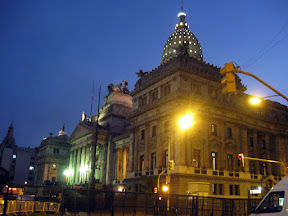
Clearly, Silvia was not the only one. Tuesday at midnight my friend Beth and I walked to Alfonsín’s home at Santa Fé and Rodriguez Peña where there was a sizeable gathering. Acknowledging the solemnity, I did not take photos. I did however take photos of the huge crowd outside of Congreso, the Argentine capitol building, waiting to pay respects at Alfonsín open-casket wake the next day.


Lines wrapping around themselves in coils of four stretched four blocks from Rivadavía and Callao until Sarmiento, then as a solid line to Corrientes. Sporadically, these large groups would break into claps of “Al-fon-sín,” which seemed to help along the several hours wait of the after-work crowd. I saw plenty of flowers, many teary eyes, and lots of folks wrapping themselves in Argentine flags. Many were supporters of UCR, to be sure, but I am certain that many Judicialist Party (Peronist) members stood among their ranks, in an appropriate stand of democratic solidarity.

Although I experienced them, I did not write about the Day of Human Rights or the Mother of Plaza del Mayo, who march every Thursday to honor their disappeared, but I will acknowledge them now. In the midst of cosmopolitan, modern Buenos Aires, it’s sometimes easy to not see Argentina’s tragic and all-too-recent past. Alfonsín’s transition of power to Menem is considered the embodiment of the consolidation of Argentine democracy and his death is a poignant reminder that Argentine democracy, both politically and institutionally, still has much more to grow.

For more reading on the subject, I suggest the flattering NY Times obit and today’s similarly-themed article, “Argentina Mourns Raul Alfonsin, an Honest Leader.” In Spanish: Clarín’s obit.

Saturday, April 4, 2009

no hay monedas


Rather than buy a reloadable plastic subway card or paper 10-ride passes, I buy my subway cards in two-ride or occasionally even one-ride units. This means that one out of every two rides requires standing on line and waiting to buy a subte pass. What is the reason for this madness? If I didn’t buy individually and in small quantities, I’d have to wait on 45-minute lines at the bank to get enough monedas (coins) for the privitized -- and therefore, non-uniform -- bus system, which doesn’t accept bills or any sort of prepaid cards. And even if I did wait at the bank, I’d probably get no more than $5 pesos anyway. 

Even though BA doesn’t usually feel all that different from other busy noisy highly developed cities, it’s amazing how inefficiencies lead to other inefficiencies: no monedas, long subte pass lines. 

For more on the moneda shortage, read Slate’s funny piece.

Sunday, March 29, 2009

battery says it best: i spend half my time with friends (friends!) hoping it never ends (ends!)

Sometimes I feel just so very lucky to have hardcore in my life. In many ways, it’s been a gift that just keeps on giving. I’ve always seen it as a refuge for kids who felt different. Lately, perhaps as a consequence of feeling the alienation of being someplace new, I've been thinking about hardcore all of the time. After neglecting the habit, I’ve been reading hardcore blogs (oh doublecross is too good) and discovering new (to me) music, listening to a crop of stuff that I’ve always wanted to listen to but am just now really getting into for the first time really (see: BATTERY, bt1k, early shelter, common cause, remains to be seen, and CIV). And just as I’ve always felt about it – this asylum for kids who feel somehow a step apart – hardcore has been embracing me. 

Wednesday I had some extra time after a visa appointment so I stopped into Axel’s tattoo shop, which was later followed by a conversation about the Disengage EP and how hardcore might not have recovered from the awesomeness if YOT had made a full length of Disengage quality. Then Friday night I literally ran into Axel and his friend as I was walking to meet up with a friend and her parents. I was majorly running on Argentine time (aka late) but it was just so great to run into a friend like that. Stressing that is important; it’s not uncommon for me to run into American kids from my program around town because we all tend to hang out in more or less the same places, but it was a sublime thing to find myself cheek-kissing with a real porteño before hitting a series of subjects about which I have something substantive to say. 

Yesterday I was cared for (babysat?) by the kids down here. When I didn’t hear from the kid who was supposed to take me to the show, his bandmate answered my call for help. I met up with him and friends and they brought me to the show, even paying for my bus fare. At the show, I received a steady stream of hellos, introductions, and unbelievable warmth. Most of the kids I met last week were there and it was super exciting to see them and to see how excited they were to see me. As they say here, it was baaaaarbaro. After the show Fedex brought me back to house, no invitation truly stated, with his friends. I listened to them and their friends and tried so hard to understand (through the slang and speed) to their talk about dudes/bands and then we played a game of charades against the Rosario kids which I totally sucked at even though I didn’t really need Spanish. It was probably the most normal night I’ve had here except that it was all in castellano! 

On the one hand, it was super amazing. I had a fun night Friday night going out with some American friends and their two British friends but it was really nice not to be made to feel like the boring/awkward person because I don’t drink. It was incredible to have a night that was just so very perfectly normal, about hanging out for hanging out’s sake. I’m so absurdly grateful for how much they went out of their way for me. On the other hand, it was bittersweet. Nothing makes you miss your friends quite like being happy and hanging out in the same way with new friends, you know? 

On a final note, it occurs to me that I haven’t used this blog to talk much about Argentina but mostly to talk about me and occasionally to use that as a prism through which to talk about Argentina. In large part that’s been because I’ve been struggling to find my place and to encounter truly authentic experiences on which to reflect. I will post more very soon – last night gave me much ammo. 

Wednesday, March 25, 2009

¡oye esteban!

If you come to the home page of this blog, you'll discover the subtitle "hay una luz que nunca se apaga" which translates into Engish as "there is a light that will never go out" aka the famous (and gorgeous) Smiths song. Perhaps now I can justify the connection.

Tonight when I was halfheartedly working on some homework for my Spanish class I happened to also be partaking in my favorite form of procrastination -- watching Morrissey videos on youtube -- and I foudn this incredible gem: Morrissey on TELEMUNDO in Spanish. 


If after this Telemundo video and "First of the Gang to Die" you still have any doubts about how much Morrissey loves the Mexicans that love him more, drink in this lovely photo of Moz in a Chivas jersey at a CHIVAS USA game. That's right, folks, MLS Chivas not even Guadalajara Chivas. Wow.

In related news, I have plans to go to a hardcore show on Saturday and the cancha between River Plate and Racing this Sunday. Hopefully the suspense matches up the awesomeness of stoppage time of the match between River and San Martín de Tucuman last week. I still can't believe it took River almost all game to come back from San Martín's weak early goal. 

If Sunday works out, it brings my life in BsAs part circle. To explain: I passed the Racing team in practice sweats outside of their hotel two Sundays ago, ostensibly waiting to go to a stadium in GBA. (They play Sundays... there is no other explanation.) Full circle would be if I make it to a Lanús game, as I passed those guys wandering around AEP Jorge Newberry in practice sweats while I was en route to Bariloche. Both times I will admit to finding the experiences extremely strange. Just sayin'-- when's the last time you saw members of your favorite football or baseball teams loitering about? 

Finally, I have a confession to make: I have been courting fandom CA River Plate. I have until April 19th's Superclasico to decide. Updates most assuredly to come.